How to spend four days in Lisbon
After enjoying trips to Paris and Rome in 2023 and 2025 respectively, I was keen to expand my European city break repertoire. The big question was: where next? Family and friends had recently visited Portugal, recommending both Lisbon and Porto. Having never visited Portugal before, the prospect of a week off in October, with the chance to enjoy some better weather than in the UK, was an opportunity not to miss. After some deliberation, we settled on Lisbon – the perfect starting point for a first-time visit to Portugal.
We had four full days to explore the area, staying for five nights in an Airbnb a stone’s throw from the main Praça do Comércio and Rua Augusta, two of the main pedestrian and shopping areas in central Lisbon. Although the Airbnb sadly didn’t quite live up to expectations – there was no hot water to the kitchen sink and the TV didn’t work – what did work well was the location. I’d recommend staying as close to the centre as possible to make the most of the experience.
During our four days, we mixed exploring Lisbon on foot with train journeys to sights outside the city. Here’s how we spent our time:
Day 1 – Alfama, the oldest district in Lisbon
After a day of travelling the day before, our first day was always going to be spent exploring central Lisbon, rather than travelling further afield. Alfama is the oldest district in Lisbon, filled with quaint cobbled streets and a multitude of Lisbon’s famed tiled houses. You can easily spend the whole day meandering around these streets, passing many a tram and tuk-tuk along the way. Our destination was the Castelo de São Jorge, Lisbon’s iconic castle at the top of a hill overlooking the city. The castle is well worth a visit, along with a stop at the Miradouro de Santa Luzia observation deck to break up the uphill climb.
 Castelo de São Jorge
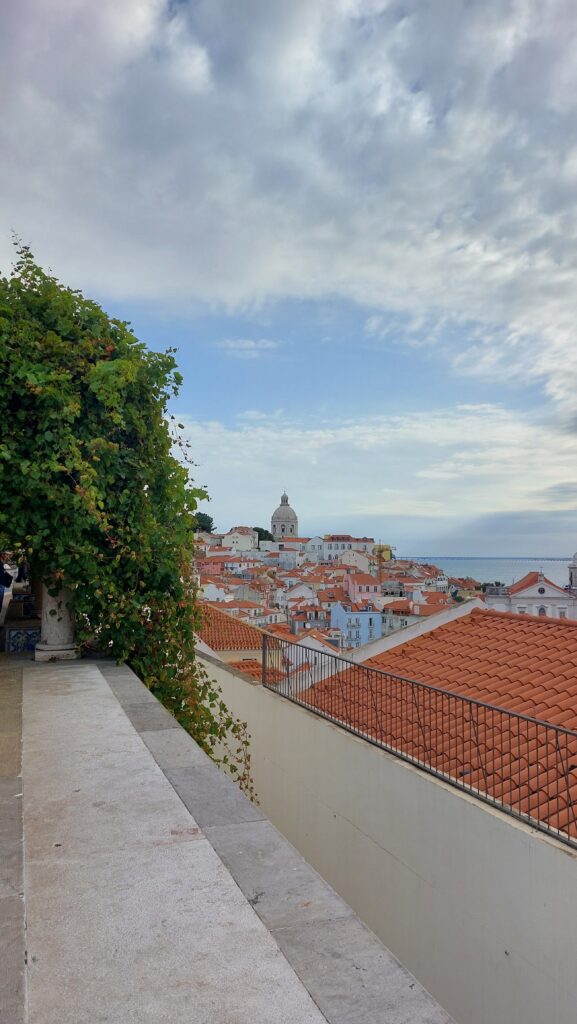 View from Miradouro de Santa Luzia
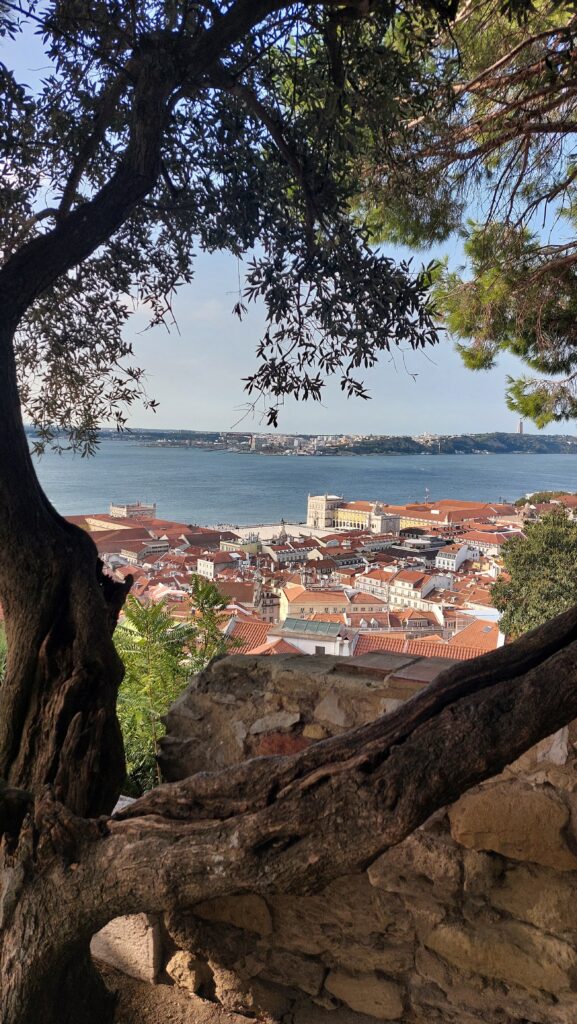 View from Castelo de São Jorge
 Praça do Comércio
 Elevador de Santa Justa
After exploring the castle, we walked through Alfama to the Monastery of São Vicente de Fora and the National Pantheon, before heading back along the waterfront to Praça do Comércio and the Elevador de Santa Justa, an ornate Victorian lift in the heart of the city.
This was the ideal first day to get a feel for central Lisbon, particularly as a first-time visitor. There were also plenty of opportunities to shop and eat along the way.
Important: If you are planning to visit Lisbon, do be prepared for the crowds. If you are planning to visit any major tourist sites, book tickets in advance if you can or get up early before the rush. Situated on the Tagus estuary, which opens into the Atlantic Ocean, Lisbon is a popular stopping point for cruise ships, which add to the crowds.
Another thing to note is that it’s rare to find a free attraction. In the UK, especially London, we can visit places such as the British Museum, Natural History Museum and Science Museum for free. This is not the case for Lisbon. Many attractions, even small niche museums and some of the botanical gardens, charge an entry fee.
Day 2 – Sintra
If you’re having an extended stay in Lisbon, getting the train for a visit to Sintra should be on the list. Sintra is a historic town and UNESCO World Heritage Site situated to the northwest of Lisbon, around a 40-minute train journey from Rossio station. There are many attractions in Sintra, including multiple palaces due to its royal heritage.
The most well-known sites to visit are:
- Pena National Palace and Park
- Quinta da Regaleira
- Castle of the Moors
- Sintra National Palace
- Monserrate Palace and Park
If you’re just going for the day, like we were, it’s impossible to visit all these locations, so I would pick your top two based on your interests. Once you’ve arrived in Sintra town centre, getting the bus to these attractions is a must, particularly if you’re visiting Pena National Palace and the Castle of the Moors, both of which we chose because of their proximity. The sites are at the top of a steep hill and little parking is available. The 434 is the main tourist bus, with frequent trips stopping outside the entrances.
I must reiterate how important it is to plan your trip as far in advance as possible and book tickets to the sites you wish to visit, as timeslots fill up quickly.
Our first stop was the Castle of the Moors, a historic castle dating back to the 8th or 9th century, surrounded by forests and rocks which made it feel rather magical. Although much of the castle is now in ruins, the castle walls remain intact and walking around them is a truly dramatic experience. Normally, you can expect incredible views, although we went on a particularly misty morning and couldn’t see a thing! However, this created its own unique experience and added to the mystical feel.
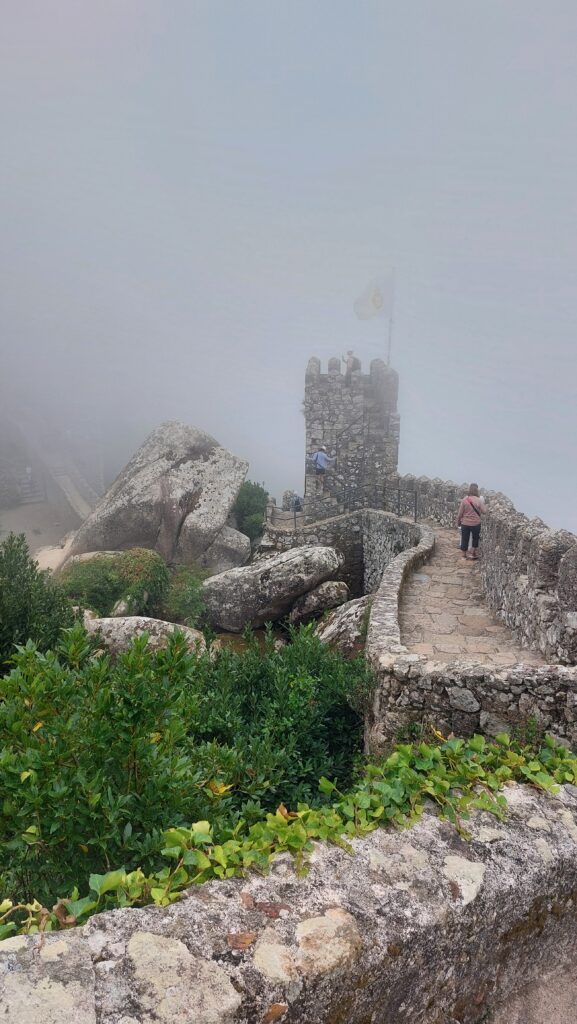 Castle of the Moors
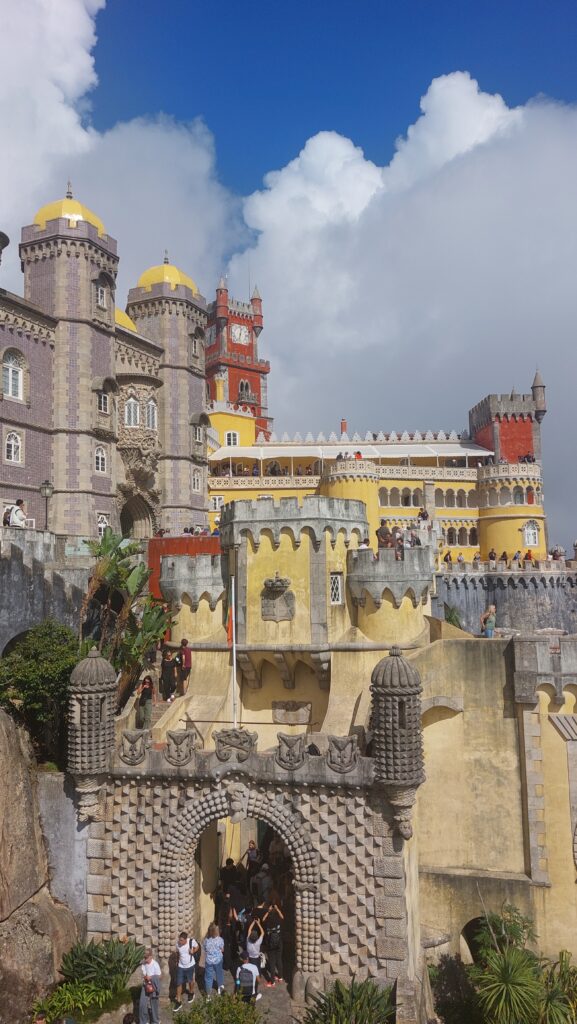 Pena Palace
A short walk from the entrance to the Castle of the Moors is Pena National Palace and Park, probably the most famous site in Sintra and known for its bright colours, impressive views and links to Romanticism. The mist had cleared up by this point and it was rather spectacular.
However, as expected, the site was heaving. The sheer number of people and queues made you feel like you were at a theme park rather than a historic palace. Although Pena is the much bigger site, I preferred the Castle of the Moors, which was quieter and felt more authentic.
Day 3 – Belém
We stayed in Lisbon for day three and took the short journey to Belém, a riverfront district of Lisbon, probably most recognisable for the Belém Tower and the Monument to the Discoveries. It was a relaxing stroll to see these sites. We didn’t go inside either, as you had to pay, but both were impressive to see from the outside. The riverfront at Belém also offers great views of the 25 de Abril Bridge, a red suspension bridge crossing the Tagus River and probably the closest thing you’ll find in Europe to the Golden Gate Bridge. Across the river, you can also see the Sanctuary of Christ the King, a 110-metre monument, including its pedestal, inspired by Christ the Redeemer in Rio de Janeiro. There were moments when you felt like you could be in Lisbon, San Francisco and Rio de Janeiro all at once!
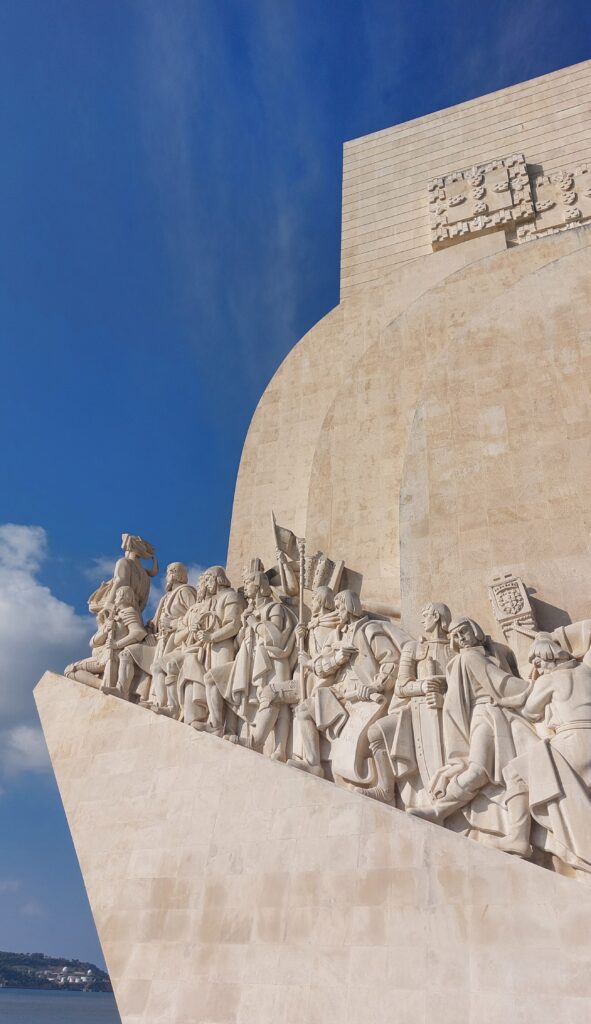 Monument to the Discoveries
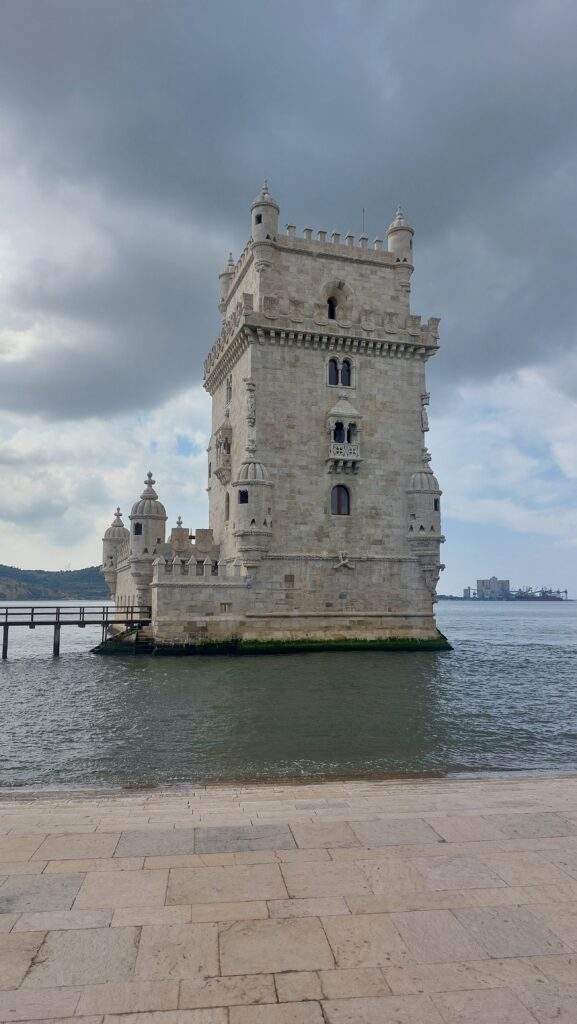 Belém Tower
We then crossed over the main road to see the Jerónimos Monastery in Belém, which was unfortunately covered in scaffolding when we went, but I can imagine how impressive it must look without it. Belém is also the place to go for pastéis de nata, the world-famous Portuguese custard tarts whose recipe originated with the monks at the Jerónimos Monastery. Most people will head straight to the Pastéis de Belém shop to buy their tarts, but we went next door to Manteigaria, which had far shorter queues and where you could see the tarts being made. While custard tarts are not my personal favourite, I could appreciate how good they were and it wouldn’t be a trip to Lisbon without giving them a try.
Day 4 – Cascais
For our final day in Lisbon, we wanted something more relaxing, so we headed to Cascais on the train. Cascais is a coastal resort town, around a 40-minute train journey from Lisbon. It has a more upmarket feel, even having an Aston Martin shop in the marina. The sandy beaches in Cascais are ideal for some sunbathing, while the cobbled streets are filled with shops and restaurants. As we were by the sea, we naturally had to get some gelato too. The marina is well-maintained and I’d recommend making use of the public toilets here!
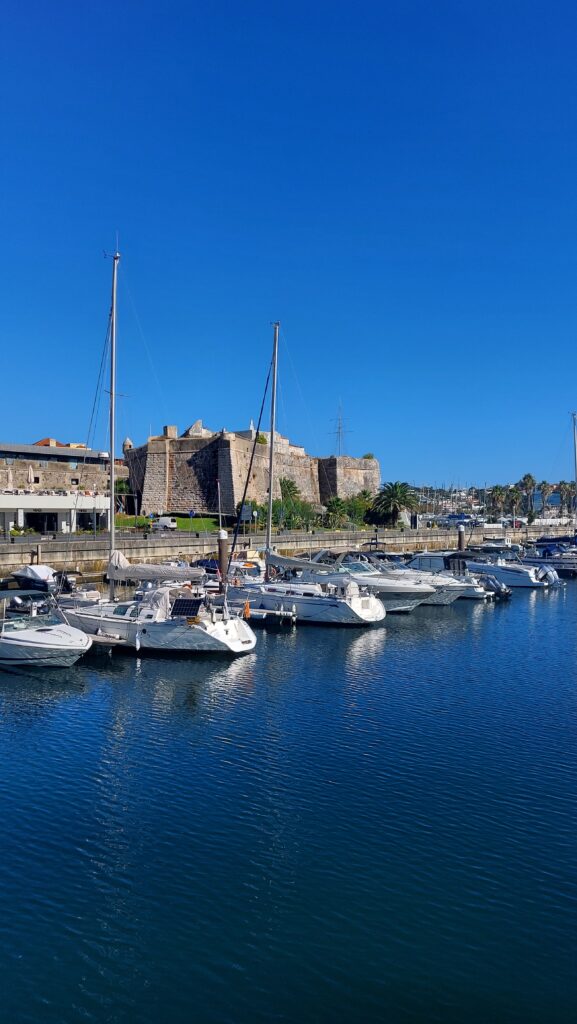 Cascais Citadel
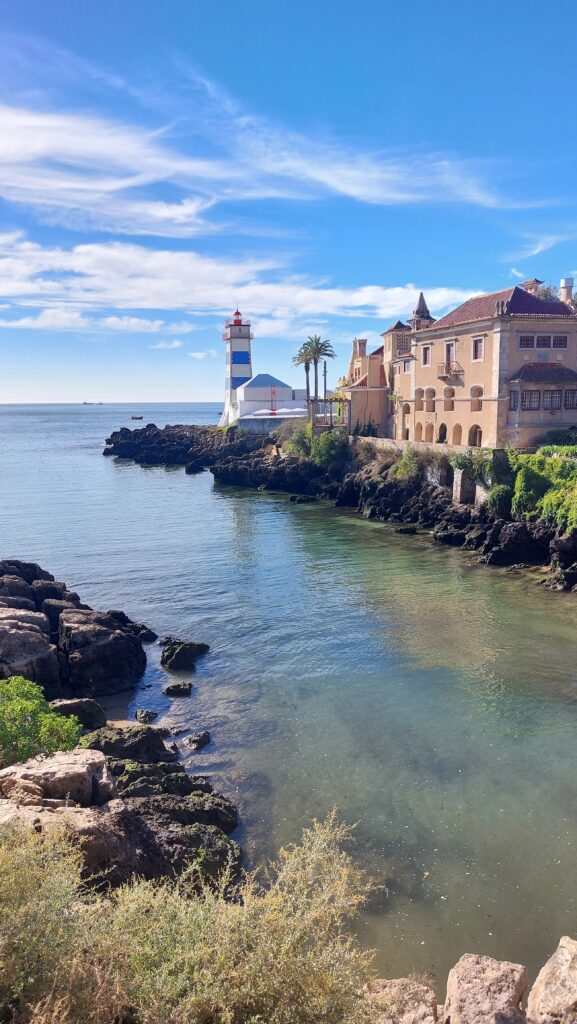 View over to Santa Marta Lighthouse
 Palm trees in Cascais
 One of the beaches in Cascais
From the centre of Cascais, you can take a short walk to Boca do Inferno, a dramatic natural sea arch in the cliffs, before heading back for a drink by the Santa Marta Lighthouse and Museum and an explore of the Cascais Citadel.
If it’s a sunny day and you are seeking some shade, visit the public park, Parque Marechal Carmona, where you may also come across some roosters, peacocks and turtles.
Alas, when we returned from Cascais, it was time to pack up and get ready for our flight home the following day.
Overall, a fantastic four days visiting somewhere new, and I’d recommend a trip if you haven’t been before.
The only downside? If I had to pick something to be slightly more negative about, it would be the food. Like any major capital city, Lisbon offers a wide variety of cuisines. However, we wanted to get a flavour of Portuguese cuisine. Being by the coast, there is naturally a lot of fish and seafood. Cod and octopus seem to be the favourites there. Whilst the quality of the fish is incredible, many meals seem to centre around a simple grilled piece of fish or seafood, usually accompanied by a side salad and some potatoes. This is nice for a meal or two and certainly makes you feel healthier, but it didn’t feel like there was a lot of variety. Perhaps we just chose the wrong places to eat though – who knows?