Yoga and Wellbeing: Interview with Liv from Yoga Crohnie
For our first interview feature, Hearth welcomes Liv Haskey aka the Yoga Crohnie, who shares her thoughts on all things yoga and wellbeing. Perfect timing to kickstart 2021’s World Wellbeing Week and International Day of Yoga celebrations.
What does wellbeing mean to you?
Wellbeing is a funny word, especially if you are living with a chronic illness because feeling ‘well’ comes and goes very quickly.
For me wellbeing means a sense of wellness (and I don’t just mean health wise). Being content, happy within myself and with friendships and relationships in my life is a huge part of it for me. Feeling balanced both mentally and physically, having my emotional needs met, my boundaries in place and being able to feel connected to what’s important to me. I think that this all contributes to a feeling of wellbeing.
What are some core principles of yoga?
When we look back at yoga when it originated over 4000 years ago, movement wasn’t a big part of the practice. Asana (yoga movement) was just a few seated poses held for long periods of time. The physical practice, that a lot of us gravitate towards nowadays, came into the practice a lot later in the 60s and 70s.
One of the main principles of yoga that I always gravitate towards is the settling of the fluctuations within the mind. For a lot of people that are experiencing stress through their jobs, health issues, general life stress, settling the mind and finding practices within yoga to help calm the mind is so important. Meditation and Pranayama can allow us to practice mindfulness and drawing our senses inwards away from the outside stimulus (Pratyahara) to settle the mind and also calm the body by calming the nervous system.
Ahimsa, which in the 8 Limbs of Yoga, is one of the 5 laws of life (Yamas) and translates to non harming/ non violence. I practice ahimsa on and off the mat, by trying to be kind and compassionate to myself and others. I am also practicing compassion and kindness towards animals and nature by choosing to be vegan. It’s just something that I wanted to do after being vegetarian from a young age, it felt natural for me to take that next step. Satya is another one of the Yamas which translates to truthfulness. Knowing and owning your truth which can also be practiced on and off the mat, remembering what is important to you in your life and not changing who you are for anyone. I think that it’s incredibly empowering to know your truth. This also leads nicely to another of my favourite of the 5 ways of living (Niyamas) – Santosha – which translates to contentment and satisfaction. Being content with ourselves, with what we have and also don’t have. Practicing gratitude and being grateful for the smaller things in life helps me to connect to feeling Santosha.
What benefits can yoga have on your wellbeing and have you noticed anything particular in your own journey, people you’ve worked with or the wider world?
There are so many benefits to practising either movement, breathwork or meditation. Finding a practice which allows you to connect back to yourself – physically, emotionally, energetically and spiritually can be incredibly beneficial to our sense of wellbeing.
Within my own journey with chronic illness, yoga has had huge positive benefits on my mental health.
When I was feeling incredible lonely because of my condition, I could go to a yoga class, move and breath and connect with the room of people and not even think about my illness, what was happening in the rest of my life and it didn’t matter.
I love being able to build confidence and strength within my own practice, taking back a sense of control within my body after feeling so out of control.
Practicing breathwork, meditation and movement can bring a sense of calm to the mind and body by connecting to our parasympathetic nervous system (rest and digest) which is ideally where we want to be most of the time. Sadly because of life’s stress and pressure most of us will be more within our sympathetic state (fight or flight) most of the time. Learning to utilise the breath can help to calm the nervous system down, which can focus the mind away from anxiety and stress.
How did you get into yoga?
In my early 20s I was living in London, working in the fashion industry and I was definitely burning the candle from both ends! I was looking for something to do after a busy day to bring a bit of relaxation and balance into my life as it was pretty hectic and stressful.
I went to a yoga class in the village hall in Walthamstow, in East London with my housemate at that time. She had been practising on and off since she was a teenager. I can’t remember the class much but I remember that I felt so mentally calm afterwards I went home and to sleep that night and completely slept through my alarm! I couldn’t wait to go back the next week to get that sense of relaxation that I couldn’t get anywhere else.
Yoga has become so much more to me than just a practice, it grounds me, comforts me, empowers me, it’s my career, it’s my life! When I’m practising yoga, it’s one of the only things in my life that I don’t think about anything else whilst doing it. It’s a complete mindful connection between mind and body.

You live with Crohn’s Disease, a chronic autoimmune illness. There’s some stigma and misconceptions surrounding chronic illness and trying complementary therapies/activities in addition to medical treatment. Do you think yoga can have a positive impact when it comes to chronic illness and in what ways?
I still take a medication for my own condition as I was struggling to find remission without.
But my thinking is that why would I not try to use other therapies or activities to benefit my wellbeing and allowing myself to feel healthier, stronger and more confident both physically and mentally?
I believe that we have to take part of our conditions into our own hands and look after ourselves as much as we possibly can because these conditions are with us for life and we only have one body and one brain.
Mind-body based therapies have been studied within the medical field through many random clinical trials and have been proven to improve patient’s overall wellbeing. The breath being the heart of our practice, allows us to trigger our parasympathetic nervous system which in itself has huge benefits to our health and wellbeing.
Movement is great for the body (as long as you can find a movement which is right for you). We release proteins and chemicals when we move our muscles which can travel through the blood/ brain barrier and make us more resilient to stress. Relaxation helps us to strengthen our brain-gut axis. When the mind is stressed, the gut will also be stressed so I think that it makes complete sense to try these other therapies alongside our medical therapies to give ourselves the best possible quality of life that we can.
There are many different types of yoga. For people living with chronic illness, are there particular types you would recommend or even certain poses/moves?
If you are new to yoga, I would always start with a gentle practice so that you can build up your confidence, strength and knowledge of the poses.
Gentle yoga and also Yin and restorative are all lovely practices to calm the body and take some time for each pose with the breath to relax.
If you have a busy or anxious mind and sitting still makes it worse, I would advise to try a flow class, where the movements are connected to the flow of the breath creating more of a moving meditation. I personally prefer strong flows that allow for intuitive movement, where I can really tune in to what my body and mind need that day.
There are a few recorded yoga practices for digestion on my Youtube ‘YOGA CROHNIE’ which can also be a great place to see what works for you.
Is there any advice you would give to someone starting yoga for the first time or who is maybe even a bit sceptical about yoga as a wellbeing practice?
If you are trying yoga for the first time, I would always say be open to learn when you step on your mat!
Yoga is more about learning about yourself than it is learning about the poses. You may not like some styles of yoga movement or the way all teachers teach so I would go to different classes with different teachers and see what works for you, and be open to the journey.
Be kind and patient with yourself. It’s very easy as a beginner to want to do all the ‘moves’ straight away but that is never the end goal. There will be things you find challenging both physically and mentally but yoga is a practice. It is different every day, you are different every day and that’s what I think is the beauty of yoga.
One of the good things about online yoga classes since lockdown is that you can come to a class but you don’t have to leave your home, so if you are nervous about being a beginner in a studio setting, you can try online first, build confidence and see if you enjoy the practice. I teach group live classes online and I also teach 1-2-1’s which I love as I am able to work with the individual student and we are able to explore their needs, interests and difficulties to deepen their practice.
If you are sceptical about yoga as a wellbeing practice…. well, what have you got to lose? There is so much to gain and if you try it and realise it’s not for you at least you gave it a go.
Final question: What does your dream yoga practice set up look like such as clothing, equipment, setting?
This answer will always be outdoors for me!
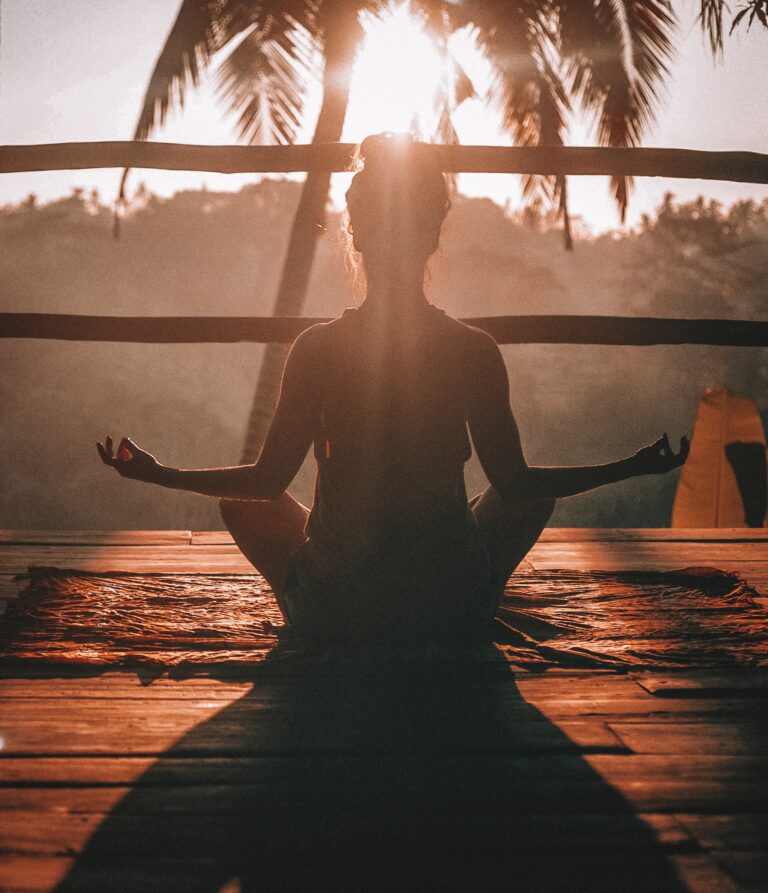
Being able to practice within nature and being immersed by the sounds, smells, natures elements, the breeze, the sun, rain, the sky above and the earth below. I always feel as though I am so much more connected to the universe and mother nature, and for me this is what it is all about, being a part of something much larger!
Liv Haskey is a yoga teacher and Crohn’s fighter, motivated by positive thinking, self care and healthy living. You can find out more on the Yoga Crohnie website, yogacrohnie.com and @yogacrohnie on Instagram.